
“I’ve Got The Power”⚡️Electricity during the build stage…

One of the unexpected headaches in this project has been arranging electricity onto the site. What should have been as simple as choosing single or three-phase and paying the connection fee has turned into months of design work and revised estimates. With several new properties all trying to connect at once, the DNO has produced multiple engineering designs — the highest landing at around £14,000. I’m now waiting on a revised single-phase quote nearer £6,000 once the ECCR (Electricity Connection Charges Regulations) are applied.
In the meantime we need power now. Tools, lighting, and welfare cabins can’t wait.
A Smarter Temporary Setup
Rather than leave a diesel generator running full time, we’ve invested in equipment that will serve us both now and later. The approach is simple: the generator charges a battery, and the battery (through an inverter) powers the site.
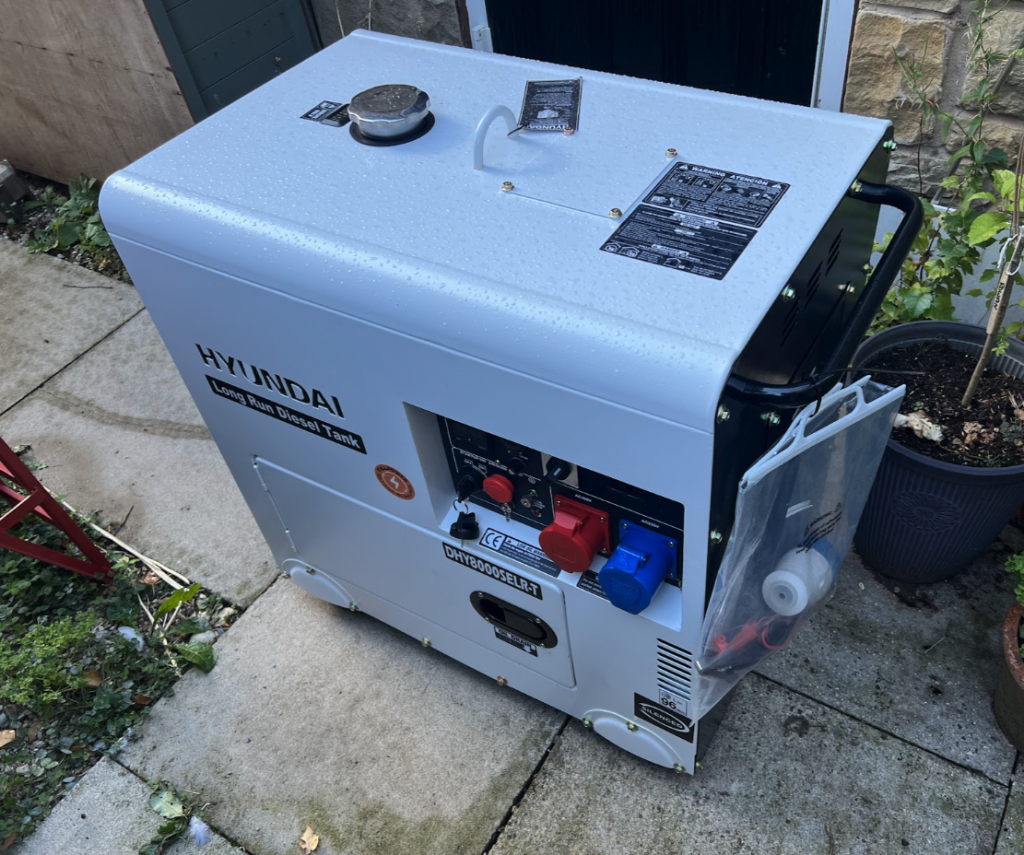
- Generator: A Hyundai 6 kVA diesel, sized to keep up with charging.
- Battery: One Fogstar 16 kWh lithium unit, required later for the barn.
- Inverter: One of three Victron Quattro 48/10000 inverter/chargers, already bought for installation in the barn
The generator will only run for short bursts to recharge the battery — around 1–2 hours at a time. Most of the day, the site will run quietly from stored energy.
Generator on Wheels
We also didn’t want a generator left sitting in a field. Aside from noise and security risks, there’s the hassle of storing diesel. The solution was a small trailer: the Hyundai can be towed in once or twice a week, run to top the battery, and then taken away again.
This setup also makes fuelling far easier. Instead of filling jerry cans, we can stop at the garage on the way, brim the 30-litre tank directly, and tow it in full. Much simpler, much safer.
How It Will Work Day to Day
A typical construction day might draw 5–10 kWh from the Fogstar for tools, lights, and the cabin. After two or three days, the generator comes in, runs for an hour or so to top the battery back up, and leaves again. The rhythm is clean, quiet, and efficient.
With diesel at today’s prices, that works out at around £0.70 per kWh. It’s not cheap compared to the grid, but far better than running the generator flat-out for every drill and saw.
Transition to the Finished Barn
Once the build is complete, the same kit moves indoors as the permanent power backbone:
- Inverters: All three Victrons working together, giving around 30 kVA continuous capacity and up to 60 kVA peak.
- Batteries: Expanded to three Fogstar units for 48 kWh usable storage — enough for a couple of days of normal use without the grid.
- Tariffs: The plan is to charge the batteries overnight on a cheap EV tariff at about 7p/kWh, then run the barn during the day instead of paying 22p/kWh.
- Future solar: Panels will be added later, cutting bills further. UPDATE I bought 28 solar panels, earlier than required, but bargain bankrupt stock I couldn’t pass by.
And even though the barn will only be connected on single-phase, day one, the Victron system is clever enough to emulate three-phase from the batteries say if we choose a three phase ASHP.
The Numbers in Perspective
- During construction: About £0.70 per kWh from the generator.
- In the finished barn: Charging overnight at £0.07 per kWh and avoiding daytime power at £0.22 per kWh should save more than £1,500 per year.
- System capability: 48 kWh of storage, 30 kVA continuous draw, 60 kVA peak draw.
- UPDATE, a new blog post on power. We’ve now calculated the savings will be closer to £3k a year!
Looking Ahead
While getting the power from the grid is frustrating experience, it has pushed us on track to a good long-term design. Right now, the trailer-towed generator and battery system will see us through construction with minimal hassle. And when the dust settles, the same kit will carry on — cutting bills, balancing loads, and powering the barn for years to come. Except the generator, that will be for sale.


Recent Comments